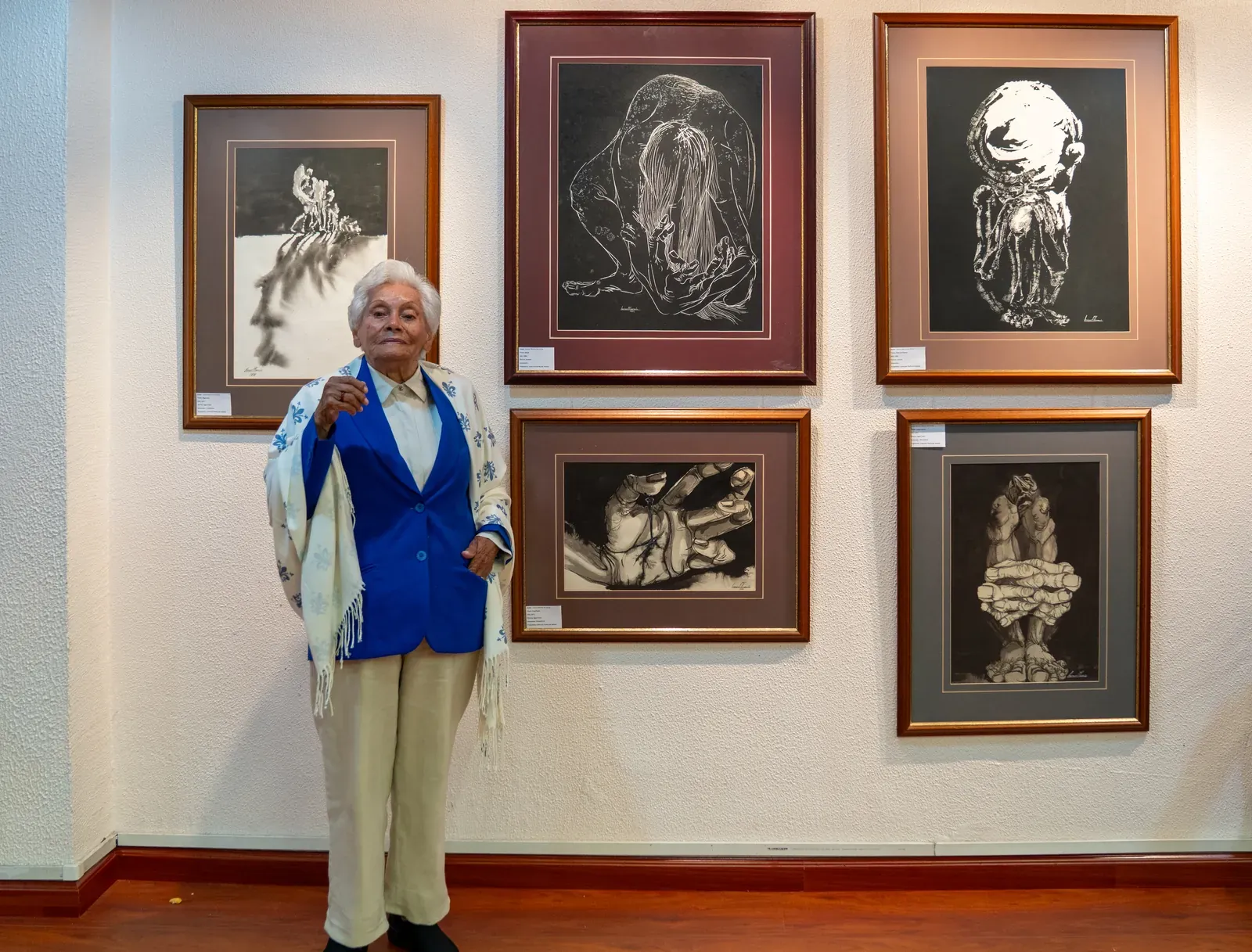
Leonor Merino de García was born in 1927 in La Paz, in the province of Carchi, and trained at the Escuela Nacional de Bellas Artes in Quito. A painter, draughtswoman and sculptor, she has worked for more than six decades in oil, watercolour, ink and wood, with a body of work shaped by the human figure, landscape and faith.
In 1962 she won First Prize at the First National Women’s Painting Salon, and in 1968 she was the first woman to show figurative work at the First Biennial. She has exhibited in Quito, Guayaquil, Cuenca, Mexico City, Bogotá and Chile, and for many years taught watercolour and art to new generations.
Her works belong to institutions and private collections in Ecuador, Austria, Germany and the United States. Her wooden sculptures of the Risen Christ and the Lord of Mercy stand in the Church of Fátima in Quito.
What the critics said
“Leonor Merino de García is one of those special and important cases within the broad panorama of Ecuadorian art. Mother, artist and teacher: three seemingly dissimilar roles in a single woman.”
— Carlos Villasís Endara, May 1977
“Out of an atmosphere of sepias and greys, the work of Leonor Merino de García emerges clean and vigorous. Rich in textures and glazes, harmonious and balanced in its composition, she is one of the figures of the national art scene who practise the craft with full responsibility.
From her palette emerge man and landscape, with clear chromatic values and a power of aesthetic communication that captures the viewer’s attention.”
— Eliodoro Aillón, Quito, 1981
“A painter of outstanding artistic qualities, who for some time now has been giving us – sadly only from time to time – the brilliant sensitivity of her spirit, is Doña Leonor Merino de García, whose exhibition we are admiring today. Already on the benches of the School of Fine Arts she showed her vocation, the kind that is born, takes shape and is perfected, and then, in that hard struggle against her surroundings and her peers, little by little imposes the values that painting demands in conception, execution and colour.
For the same motif can be joyful or sad, placid or anguished, depending on the moment in which the soul discovered it to put it on canvas. And at that point Leonor Merino knows what she wants, how she wants it and the way she achieves it: qualities that are only attained with assurance, deep knowledge and creative talent.”
— Dr Ricardo Descalzi, May 1981
Career
Born in La Paz, Montúfar canton (Carchi, Ecuador), on 18 February 1927, she graduated from the Escuela Nacional de Bellas Artes in Quito.
Awards and recognitions
- 1962 First Prize of the Ministry of Education at the First National Women’s Painting Salon (Quito).
- First Prize at the National Painting Salon of the Casa de la Cultura Ecuatoriana (Quito).
- 1968 First woman to show figurative work at the First Biennial; the same year she exhibited at the Galería Kitgua.
- 1970 Success at the Cuenca Sesquicentennial Salon and an exhibition of aquatints.
- 1971 First prize and gold medal at the Ibarra Fair Exhibition, and a recognition from the Cultural Promotion Office of the Embassy of Mexico.
- 1972 Second Prize at the 16th Salón de Octubre (Guayaquil).
- 2001 Exhibition at the Mexican Cultural Centre in Quito.
- 2016–2018 Exhibitions at the Open Workshops of the Municipality of Quito.
- 2025 The “Toda una vida” (“A whole life”) homage, with the support of AFESE (Association of Officials of the Ecuadorian Foreign Service).
Solo exhibitions
Altamira, Inti Huasi and Kitgua galleries (1968, Mexico), Casa de la Paz (1968), Opic (1970), Ibarra Fair (1971), Colegio Experimental 24 de Mayo (1976, Quito), Federation of Dentistry (1978, Quito), Mexico City Museum (1978) and Alliance Française (1980).
Group exhibitions
Casa de la Cultura Ecuatoriana in Quito and Guayaquil, as well as shows in Ambato, Manta, Mexico City, Bogotá and Chile (Museo de Arte).
Teaching
She taught watercolour at the Universidad Central del Ecuador and art at the Colegio Gran Colombia, the Colegio Experimental 24 de Mayo, the Colegio Las Mercedarias and the Colegio de América.
Works in collections
Her works are held by the Casa de la Cultura, Quito branch, Produbanco-Promérica, the Colegio Experimental 24 de Mayo and private collections in Quito, Guayaquil, Austria, Germany and the United States. She also carved the wooden sculptures of the Risen Christ and the Lord of Mercy in the Church of Fátima in El Batán (Quito).
Source: catalogue of the “Toda una vida” exhibition.